To choose a web design agency, judge it on what it will put in writing: your name on the domain, hosting and copyright, a fixed price, load-time and accessibility targets, and a redirect map if it’s a redesign. Portfolios show taste. Contracts show what you’ll actually get.
Most guides tell you to read reviews and look at portfolios. Both help, and neither tells you who will control your site in two years. These ten questions do, and each comes with the answer you should hear and the one that should worry you.
How do you choose a web design agency?
Choose the agency whose answers you can check. Look at the work first, then ask every shortlisted agency the same ten questions and compare what each is willing to put in the contract. These questions to ask a web designer or agency are the ones we’d expect anyone to answer clearly, including us, and they’re the standard behind how we build websites for B2B and service businesses.
| Question | Why it matters | A good answer | A red flag |
|---|---|---|---|
| 1. Whose name will the domain be registered in? | The registrant carries responsibility for the domain | Yours, with your contact details | “We’ll register it for you,” in their name |
| 2. Whose account is the hosting in? | Whoever holds the account controls the site | Yours, and you pay the provider directly | Hosting only they can log into |
| 3. Who owns the design and code once it’s paid for? | Ownership doesn’t transfer by default | You do, and the contract says so | Silence, or a licence they can take back |
| 4. What platform, and could another developer take it over? | A common platform keeps you free to move | A widely used platform, with full admin access handed over | A proprietary builder only they can edit |
| 5. What’s the fixed price, and what would change it? | Open-ended day rates drift | A number, plus the few things that would move it | “It depends,” with no number |
| 6. How fast will it load, measured how? | “Fast” is measurable | Core Web Vitals targets, in writing | “It’ll be fast” |
| 7. Which accessibility standard will it meet? | Accessibility has defined levels | WCAG 2.2 Level AA, checked before launch | “It’s accessible” |
| 8. If it’s a redesign, where’s the redirect map? | Old URLs that break lose their search traffic | Every old URL mapped to a new one before launch | Everything redirected to the homepage |
| 9. Can my team edit it without you? | Small changes shouldn’t need a developer | Editable sections and a walkthrough at handover | Every change goes through them |
| 10. What happens after launch, and if we leave? | Lock-in shows up after launch, not before | Optional ongoing care and no handover fee | An exit fee, or no answer |
The last column doubles as a list of web design agency red flags. Questions 1 to 4 decide who controls the site. Questions 5 to 8 decide what you’re buying. Questions 9 and 10 decide what living with the site will cost after the agency has gone.
Who should own the domain, hosting and code?
You should own all three, in your own name, from day one. The agency can set them up, but the accounts and the rights should be yours, because whoever holds them controls the site long after the project ends.
Start with the domain. ICANN, which oversees domain names, tells registrants that “You will assume sole responsibility for the registration and use of your domain name”, and that the registrant’s details must be accurate. If the agency registers the domain in its own name, that responsibility sits with the agency, not you. Ask to see the registrant details before launch.
Hosting works the same way. If the hosting account is yours, you pay the provider directly and hold every login. If it’s the agency’s, moving on means asking their permission.
Copyright is the one most buyers assume. Under US law, the US Copyright Office explains that the author of a work is the person who actually creates it, unless it’s a work made for hire. A specially commissioned work only counts as made for hire if it falls into one of nine listed categories and both sides sign a written agreement saying so. The practical answer is simple: get ownership of the design, code and content stated in the contract.
The platform matters for the same reason. WordPress is released under the GNU General Public License, version 2 or later, so no single company controls the platform and any WordPress developer can work on the site. Our own standard is printed at the top of the page we sell from: at Crisolva, the price is fixed and agreed up front, redirects are mapped before launch, and the site, hosting and domain are in your name. There’s no handover fee if you move on.
How do you compare web design quotes?
Compare quotes on scope and on what each price includes, not on the headline number. Two quotes are only comparable when they cover the same pages, the same content work and the same integrations.
Ask each agency for a fixed price and the few things that would change it. In our case those are the number of pages, whether we write the content, CRM and booking integrations, and, on a redesign, the size of the redirect map. A quote that can’t name its own variables will move once the work starts.
Then line the quotes up against the same list: page count, who writes the words, what connects to your CRM at launch, whether hosting and domain setup are included, and what happens after launch. An agency that publishes its prices makes this easier. For reference, a WordPress website from us costs $1,500 for up to six pages, and our published website prices show what each plan includes.
What should “fast” and “accessible” mean in a proposal?
“Fast” should mean Google’s Core Web Vitals targets, and “accessible” should mean a named level of the W3C’s accessibility guidelines. Both are published standards, so you can write them into the contract and check them after launch.
For speed, Google’s “good” Core Web Vitals targets are a Largest Contentful Paint within 2.5 seconds, an Interaction to Next Paint under 200 milliseconds and a Cumulative Layout Shift under 0.1. Those measure how quickly the main content appears, how quickly the page responds to a tap or click, and how much the layout jumps while it loads. Ask which of the three the agency will hit, and how it will show you.
For accessibility, WCAG 2.2 became a W3C Recommendation on 12 December 2024 and defines three conformance levels: A (lowest), AA and AAA (highest). Level AA is the sensible target to name. In the US, the Department of Justice’s guidance on web accessibility and the ADA says the ADA’s requirements apply to the goods and services public accommodations offer, including online, and points to WCAG as helpful guidance.
What should you ask if you’re redesigning an existing site?
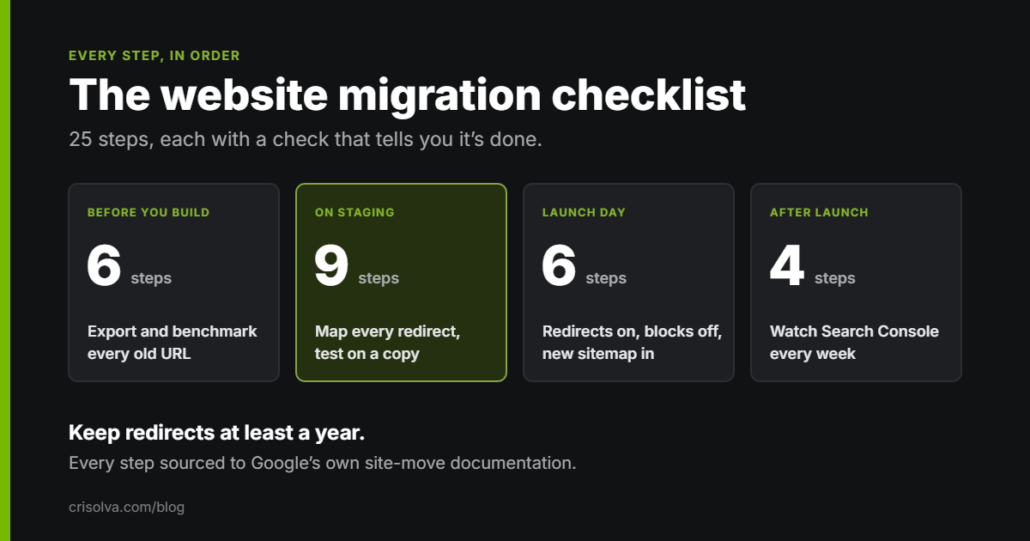
Ask to see the redirect map before launch. A redesign usually changes URLs, and every old URL that ranked or was linked to needs a permanent redirect to its closest new page, or the search traffic it brought in stops arriving.
Google’s own advice for site moves with URL changes is server-side permanent redirects from old URLs to new ones, kept “generally at least 1 year”. Google also says visibility in Search may fluctuate temporarily during the move, so treat any agency that promises zero movement with caution.
The red flag is the shortcut: every old page redirected to the homepage. We map each old URL to its closest new page with a permanent 301 redirect, never everything to the homepage, and the map is built before launch. If the site’s search traffic matters to your business, involve someone who understands it, such as our SEO team, before the new URLs are fixed.
If you’re weighing a redesign, a free website audit will show what your current site has to lose before anyone quotes you.
When is hiring a web design agency the wrong move?
Hiring a web design company is the wrong move when the problem isn’t the website, or when you can’t give a build what it needs. Hold off if any of these sound like you:
- Your current builder already does the job. If it does, we’ll tell you to keep it, and so should any agency you talk to.
- You need a full website live this week. A proper build takes at least three weeks.
- Nobody on your side can approve pages. Every page needs a yes from someone who can give one.
- You want the site judged on looks alone. A business website should be judged on enquiries.
If none of those apply, look at live sites we’ve built or anyone else’s, then put the ten questions to every agency on your shortlist. The one with the clearest written answers is usually the one to hire.
This article is general information about website ownership and accessibility rules in the US as of November 2026. It is not legal advice. Rules differ in the UK and elsewhere; check current requirements with a qualified advisor before you sign.
How to choose a web design agency: FAQs
What questions should you ask a web designer before hiring?
Ask whose name the domain and hosting will be in, who owns the design and code once paid for, and what platform the site uses. Then ask for a fixed price and what would change it, speed and accessibility targets in writing, the redirect plan if it’s a redesign, whether your team can edit pages, and what happens after launch.
What are the red flags when hiring a web design agency?
The domain or hosting registered in the agency’s name, no written statement that you own the design and code, a quote with no fixed number, “fast” and “accessible” with no targets attached, every old page redirected to the homepage on a redesign, and an exit or handover fee if you leave.
Should a web design agency register your domain for you?
It can do the setup, but you should be the registrant. ICANN tells registrants they assume sole responsibility for the registration and use of their domain name, and that their details must be accurate. If the agency is listed as registrant, that responsibility sits with them, so check the registrant details before launch.
Do you own a website you paid for?
Not automatically under US law. The US Copyright Office explains that the author is the person who creates a work, unless it’s a work made for hire, and a commissioned work only qualifies if it fits one of nine categories and both sides sign a written agreement. Get ownership stated in the contract. This is general information, not legal advice.
How should a B2B company choose a web design agency?
Ask the ten standard questions, then two more. Will forms, booking and chat connect to your CRM at launch rather than in a later phase? And will pages be built around how your buyers compare and shortlist suppliers? Crisolva builds B2B sites that way, because a B2B site exists to start sales conversations.
Sources
- ICANN, “Registrants’ Benefits and Responsibilities”, undated (accessed November 3, 2026)
- US Copyright Office, “Works Made for Hire” (Circular 30), revised August 2024 (accessed November 3, 2026)
- WordPress.org, “License”, undated (accessed November 3, 2026)
- Google Search Central, “Understanding Core Web Vitals and Google search results”, updated December 10, 2025 (accessed November 3, 2026)
- W3C, “Web Content Accessibility Guidelines (WCAG) 2.2”, W3C Recommendation, December 12, 2024 (accessed November 3, 2026)
- US Department of Justice, “Guidance on Web Accessibility and the ADA”, March 18, 2022 (accessed November 3, 2026)
- Google Search Central, “Site Moves and Migrations”, updated August 20, 2026 (accessed November 3, 2026)
Want a second opinion on your current site first?
Before you compare quotes, it helps to know what your current site gets right and what it’s losing. Our free website audit reviews speed, SEO, conversion and tracking within 3–5 business days, delivered as a recorded walkthrough or written report.
It’s free, there’s no obligation, and the findings are yours to keep either way.