A UK website costs the days of work it takes, times the supplier’s day rate, plus VAT if they’re registered. Contract designers averaged £385 a day in YunoJuno’s 2026 rates report, so page count, custom design, content and integrations explain most of the gap between quotes.
Search for a price and you’ll find ranges that overlap and contradict each other, most with no source. This guide works from a sourced day rate instead, then shows the line items that make two quotes for the same site look nothing alike.
How much does a website cost in the UK?
A website costs what the work costs: the number of days it takes, multiplied by the day rate of whoever does it, plus VAT where it applies. Any website design cost UK suppliers quote can be broken back into those parts, and that’s the quickest way to compare two quotes.
Start with the day rate. YunoJuno’s 2026 Contractor and Freelancer Rates Report, built on more than 182,000 contractor, booking and rate data points from 2024 and 2025, gives these average UK day rates:
| Discipline | Average UK day rate |
|---|---|
| Designers | £385 |
| Creatives | £417 |
| UX | £452 |
| Software Engineering | £533 |
These are rates for contractors booked through YunoJuno’s platform, not every web designer in the country, but they’re sourced, recent and in pounds. YunoJuno puts the spread between disciplines down to technical specialization, responsibility, delivery complexity and commercial impact. In plain terms, a developer building integrations costs more per day than a designer adapting a layout.
Now the days. The table below is a hypothetical example: the day counts are illustrations, not quotes, but the arithmetic shows how the same method produces very different prices.
| Scope (hypothetical) | Days (hypothetical) | At £385 a day | At £533 a day |
|---|---|---|---|
| 5-page site from a theme | 5 | £1,925 | £2,665 |
| 10-page site, custom design | 12 | £4,620 | £6,396 |
| 25 pages with CRM and booking integrations | 30 | £11,550 | £15,990 |
All figures are before VAT. Ask any supplier how many days their quote assumes; if they won’t say, you can’t compare it with anyone else’s.
Why do UK website quotes differ so much?
Quotes differ because they price different jobs. One includes the copy, the CRM connection and the cookie setup; another prices the design and leaves the rest to you. Published web design prices UK guides quote don’t agree for the same reason: each assumes a different scope, and most don’t say which.
Line the quotes up against this list before you compare totals.
| Line item | Why quotes differ | Ask the supplier |
|---|---|---|
| VAT | Some quotes add 20%, some suppliers don’t need to | Is this price including or excluding VAT? |
| Page count | Each page is design and build time | How many pages, and what does an extra page cost? |
| Template or custom design | A custom design takes more days | Is the design built for us or adapted from a theme? |
| Content | Writing the words is separate work | Who writes the copy, and is it priced? |
| Integrations | Forms that feed a CRM or booking tool take build time | What connects to our CRM or calendar at launch? |
| Hosting and domain | Paid to a provider, often outside the build price | Whose name are they in, and who pays the provider? |
| Legal pages and cookie consent | Company details, privacy information and consent setup | Are these included and set up? |
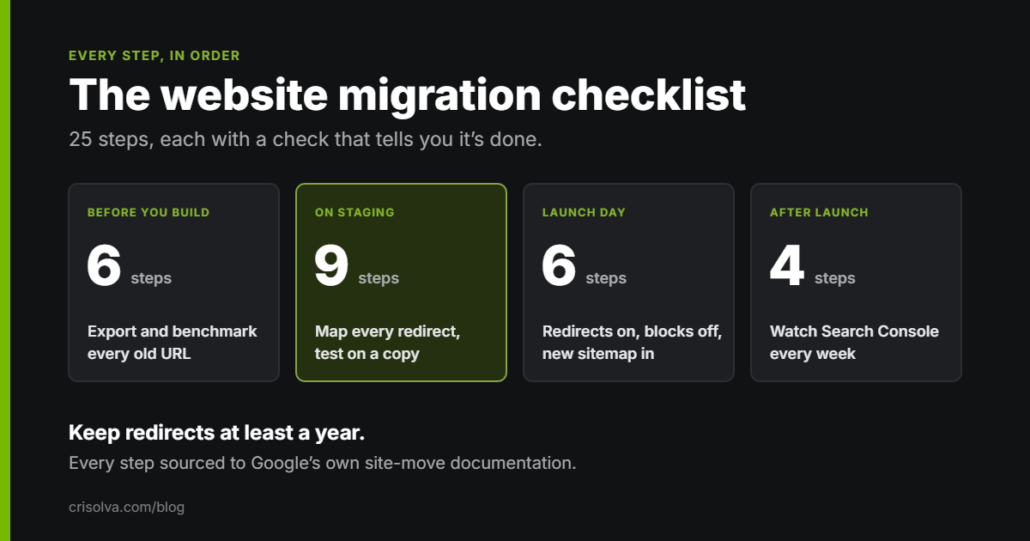
| Redirects on a redesign | Old URLs need mapping to new ones | Is a redirect map included? |
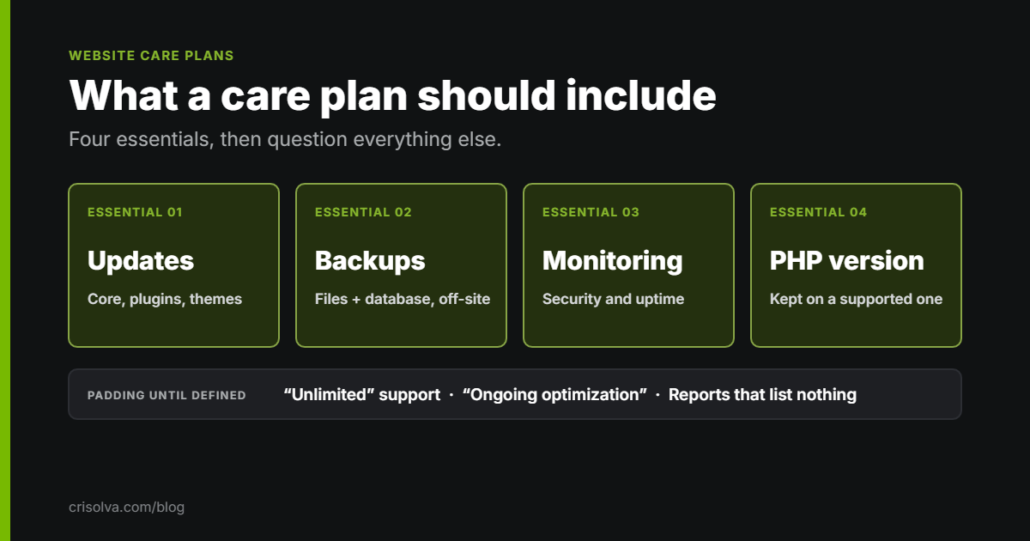
| Care after launch | Updates and backups are ongoing work | What’s included after launch, and what does it cost? |
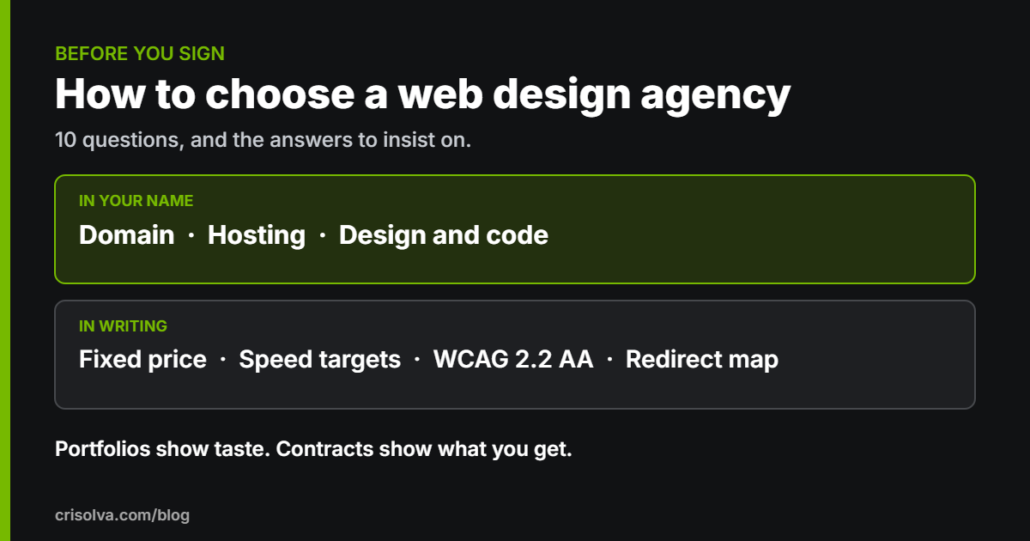
The cheapest quote is usually the one with the most “no” answers. That isn’t always wrong, but you should know which rows you’re paying someone else for later. If it’s a redesign, the redirect row is the one that protects your search traffic; the full website migration checklist shows what that work involves. And if you’re still choosing between suppliers, here are ten questions to ask before you sign.
Is a website quote plus VAT?
It depends on whether the supplier is VAT-registered, so ask. GOV.UK sets the standard VAT rate at 20%, applying to most goods and services, and a registered supplier will normally add it to their price.
Not every supplier is registered. Under GOV.UK’s registration rules, a business must register once its taxable turnover for the last 12 months goes over £90,000, and can register voluntarily below that. A small freelancer may sit under the threshold and charge no VAT, so two quotes with the same headline figure can differ by a fifth.
Say, hypothetically, you hold two quotes of £3,000. If one is “plus VAT”, it’s really £3,600, and the other is £3,000 flat. Whether you can reclaim that VAT depends on your own registration, which is a question for your accountant, not your web designer.
What does a UK business website have to include?
A UK business site has legal content to carry, and a cheap quote often leaves it to you. Three items are worth checking on any quote.
First, company details. GOV.UK says a limited company’s website must show its registered number, its registered office address, where it’s registered (England and Wales, Scotland or Northern Ireland) and the fact that it’s a limited company. That usually lives in the footer.
Second, privacy information. A contact form collects personal data. The ICO’s guidance on the right to be informed says people have the right to be told how their data is collected and used, and that you must give them privacy information at the time you collect it. In practice, that means a privacy notice linked from the form.
Third, cookies. The ICO’s guide to the cookie rules under PECR sets the basic rule: tell people the cookies are there, explain what they do and why, and get their consent. Cookies strictly necessary to provide a service the user asked for are exempt. The ICO says it’s consulting on revised guidance, and its privacy guidance is under review after the Data (Use and Access) Act, so check the current position when your site is built.
None of these is expensive on its own. They matter because a quote that skips them isn’t cheaper; it just hands you the job.
What should a fixed website price include?
A fixed price should say what you get, what’s excluded, and what would change the number. Without that list, “fixed” only lasts until the first change.
Here’s ours, as an example of the format. At Crisolva, every price is fixed and agreed before work starts, and we publish them in US dollars: a WordPress website of up to six pages is $1,500, a B2B website of up to 12 pages is $2,500, and a redesign with migration starts at $2,000. An extra page is $100, and copywriting is $50 a page if you’d rather we write it.
The price moves for four reasons: how many pages you need, whether we write the content, CRM and booking integrations, and the size of the redirect map on a redesign. Some things you don’t pay for at all: the website audit, redirect mapping on a redesign, setting up hosting, domain and Search Console, and a handover fee if you ever move on. Hosting and domain fees go to the provider, in your name.
Every build includes a staging site and testing before launch, Core Web Vitals “good” and WCAG 2.2 AA targets, forms or booking connected at launch, and editable sections with a handover walkthrough. You can see the fixed website prices, published in full, including what each plan covers. If you’re holding quotes you can’t compare, a free website audit shows what your current site needs before anyone prices it.
When is a website builder the cheaper right answer?
A builder is the right answer when you need a few pages, can write them yourself, and don’t need forms feeding other systems. You pay a subscription instead of days of someone’s time, and for a simple site that’s often the sensible trade.
If you already have a site on a builder and it does the job, keep it. That’s our own rule: if your current builder can do the job, we’ll tell you to keep it. Pay for a build when the site has to do something the builder can’t: route enquiries into a CRM, carry a proper structure for each service and buyer, or move an established site without losing its search history. That’s the work we focus on in how we build business websites.
This article is general information about UK VAT, company website disclosures and privacy rules as of November 2026. It is not legal or tax advice. Check current requirements with a qualified advisor before you launch.
Website cost in the UK: FAQs
How much does a 5-page website cost in the UK?
It depends on the days the work takes and the supplier’s day rate. As a hypothetical example, 5 days at the £385 average day rate for contract designers in YunoJuno’s 2026 rates report comes to £1,925 before VAT. Ask each supplier how many days their quote assumes, so you can compare like with like.
Do web designers charge VAT in the UK?
Only if they’re VAT-registered. GOV.UK says a business must register once its taxable turnover for the last 12 months goes over £90,000, and the standard rate is 20%. A sole freelancer below the threshold may charge no VAT, so always ask whether a quote includes or excludes it.
Does a UK business website need a cookie banner?
If it uses cookies that aren’t strictly necessary, it needs a way to get consent, which is what most cookie banners do. The ICO’s guidance on PECR says you must tell people the cookies are there, explain what they do and why, and get their consent. The ICO is consulting on revised guidance, so check the current rules when the site is built.
Why are UK website quotes so different?
Because they price different scopes. Quotes vary on page count, template versus custom design, who writes the content, CRM and booking integrations, hosting, legal pages and cookie consent, redirects on a redesign, care after launch, and whether VAT is included. Compare them line by line, not by the total.
What should a B2B company budget for a website in the UK?
Budget by scope: a page for each service and type of buyer, content you or a writer will produce, and a CRM connection at launch. For reference, Crisolva’s B2B website costs $2,500 for up to 12 pages, priced in US dollars and fixed before work starts, with copywriting at $50 a page if needed.
Sources
- YunoJuno, “The 2026 Contractor and Freelancer Rates Report”, 2026 (more than 182,000 data points, 2024–2025) (accessed November 17, 2026)
- GOV.UK, “VAT rates”, undated (accessed November 17, 2026)
- GOV.UK, “Register for VAT: when to register”, undated (accessed November 17, 2026)
- GOV.UK, “Running a limited company: signs, stationery and promotional material”, updated January 29, 2025 (accessed November 17, 2026)
- Information Commissioner’s Office, “Right to be informed”, undated (accessed November 17, 2026)
- Information Commissioner’s Office, “Cookies and similar technologies”, undated (accessed November 17, 2026)
Want to know what your site actually needs before you get quotes?
Before you compare prices, it helps to know what the job is. Our free website audit reviews speed, SEO, conversion and tracking within 3–5 business days, then shows you whether you need a fix, a page or a rebuild.
It’s free, there’s no obligation, and the findings are yours to keep, as a recorded walkthrough or a written report.